

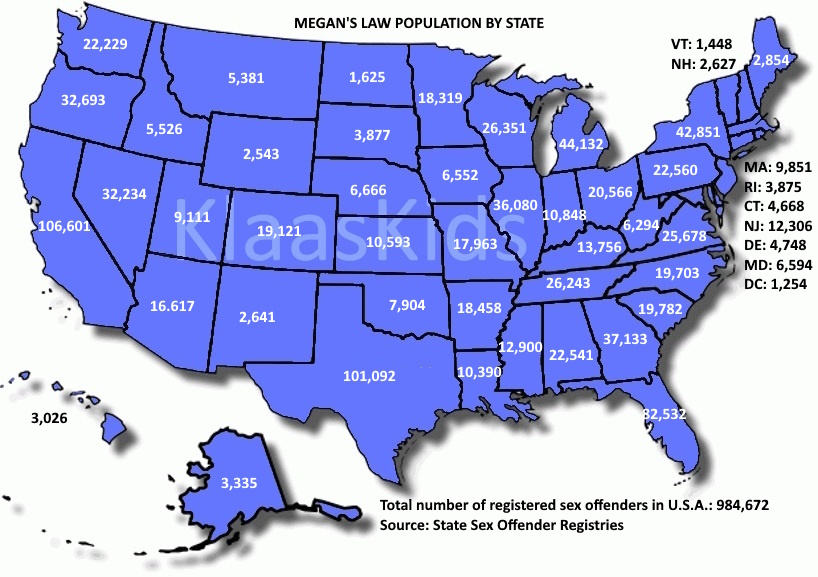
Megan’s Law by State
Washington State’s 1990 Community Protection Act included America’s first law authorizing public notification when dangerous sex offenders are released into the community. However, it was the brutal 1994 rape and murder of seven-year-old Megan Kanka that prompted the public demand for broad based community notification. On May 17, 1996, President Clinton signed Megan’s Law. Megan’s Law requires the following two components:
Sex Offender Registration – The 1994 Jacob Wetterling Act requires the States to register individuals convicted of sex crimes against children. Sex offender registration laws are necessary because:
- Sex offenders pose a high risk of re-offending after release from custody;
- Protecting the public from sex offenders is a primary governmental interest;
- The privacy interests of persons convicted of sex offenses are less important than the government’s interest in public safety;
- Release of certain information about sex offenders to public agencies and the general public will assist in protecting the public safety.
Community Notification – Megan’s Law allows the States discretion to establish criteria for disclosure, but compels them to make private and personal information on registered sex offenders available to the public. Community notification:
- Assists law enforcement in investigations;
- Establishes legal grounds to hold known offenders;
- Deters sex offenders from committing new offenses;
- Offers citizens information they can use to protect children from victimization.
In order to remain current and maintain relevance we ask the public to provide updated information that we may have overlooked, including new, broken or invalid web links so that the KlaasKids Foundation can continue to be the Internet’s premiere Megan’s Law destination.
On July 27, 2006 President Bush signed the Adam Walsh Child Protection and Safety Act. One important component requires the U.S. Justice Department to create a public accessible Internet based national sex offender database that allows users to specify a search radius across state lines. The result is the Dru Sjodin National Sex Offender Public Website.
Accessing Megan’s Law – International Efforts
Sign up for important community alerts in your area:
Search your local sex offender registry:
Search Tribal offender registries:
Absentee Shawnee Tribe of Oklahoma
Alabama-Coushatta Tribes of Texas
Cheyenne and Arapaho Tribes of Oklahoma
Confederated Tribe of the Chehalis Reservation
Confederated Tribes and Bands of the Yakama Nation
Confederated Tribes of the Colville Reservation
Confederated Tribes of the Umatilla Indian Reservation
Confederated Tribes of the Warm Springs Reservation
Eastern Band of Cherokee Indians
Eastern Shawnee Tribe of Oklahoma
Eastern Shoshone Tribe of the Wind River Reservation
Fort Peck Assiniboine and Sioux Tribes
Grand Traverse Band of Ottawa and Chippewa Indians
Iowa Tribe of Kansas and Nebraska
Lac Vieux Desert Band of Lake Superior Chippewa Indians
Little River Band of Ottawa Indians
Little Traverse Bay Band of Odawa Indians
Mashantucket Pequot Tribal Nation
Match-e-be-nash-she-wish Band of Pottawatomi Indians of Michigan
Menominee Indian Tribe of Wisconsin
Miccosukee Tribe of Indians of Florida
Mississippi Band of Choctaw Indians
Northern Arapaho Tribe of the Wind River Reservation
Nottawaseppi Huron Band of the Potawatomi
Peoria Tribe of Indians of Oklahoma
Pokagon Band of Potawatomi Indians
Prairie Band Potawatomi Nation
Pyramid Lake Paiute Tribe of Nevada
Red Lake Band of Chippewa Indians
Sac and Fox Nation of Oklahoma
Sac and Fox Tribe of the Mississippi in Iowa (Meskwaki Nation)
Saginaw Chippewa Indian Tribe of Michigan
Salt River Pima-Maricopa Indian Community
Sault Sainte Marie Tribe of Chippewa Indians of Michigan
Seneca-Cayuga Tribe of Oklahoma
Swinomish Indian Tribal Community
Te-Moak Tribe of Western Shoshone
Turtle Mountain Band of Chippewa Indians
United Keetoowah Band of Cherokee Indians
Wampanoag Tribe of Gay Head (Aquinnah)